Blog
-
Defining a Fishery: Inconsistency in Aquaculture Regulation
- January 6th, 2026 — by Savannah Schiebel — Category: Aquaculture
- Tweet
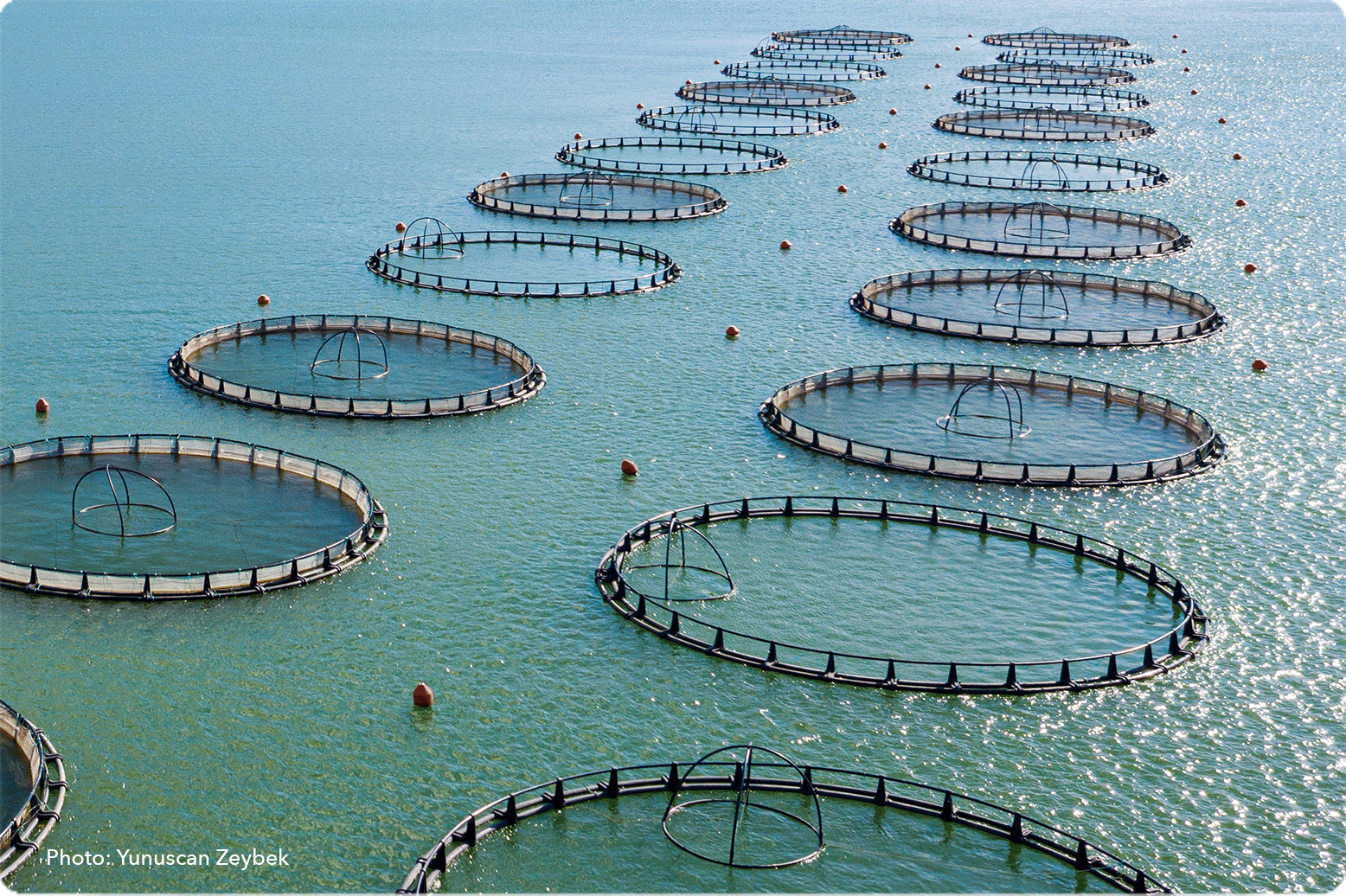
Commercial aquaculture has emerged amidst the economic growth of the seafood industry. In response to concerns over overfishing, fish farming has become a promising alternative to wild-caught seafood and currently accounts for approximately half of the world’s seafood supply according to the United Nations Food and Agriculture Organization (FAO). In the U.S., the permitting and compliance process for marine nearshore and offshore aquaculture can be lengthy and complex. One key component of regulating marine aquaculture is ensuring that farm operations do not adversely impact marine wildlife, including protected species such as marine mammals. As there are already regulatory frameworks in place for protecting marine mammals from commercial fishing activity, this raises the question of how a “fishery” is defined under federal law, and whether aquaculture operations fit within those definitions.
The Marine Mammal Protection Act of 1972 (MMPA) and the Endangered Species Act of 1973 (ESA) establish federal protections for marine mammal species and require that agencies comply with their provisions. 16 U.S.C. §§ 1361 et seq; 16 U.S.C. §§ 1531 et seq. As a part of the general environmental review process for operational permits, aquaculture operations must consult with relevant federal agencies and obtain any necessary permits, including those to incidentally “take” a marine mammal. A “take,” refers to the hunting, capturing, or killing of an animal or any attempt to do so. This also includes "harassment" of a marine mammal, which encompasses attempts of pursuit, torment, or annoyance that have the potential to injure or disturb it. 16 U.S.C. § 1362(13), (18). The National Oceanic and Atmospheric Administration (NOAA) includes aquaculture operations in its annual MMPA List of Fisheries (LOF), which regulates commercial fisheries that may experience incidental take or mortality (M/SI) of marine mammal species.
Under the MMPA, the definition of a “fishery” has the same meaning as it does in the Magnuson-Stevens Fisheries Conservation and Management Act (MSA)—the primary law that governs fisheries. 16 U.S.C. § 1362(l6); 16 U.S.C. § 1802(13). Under the MSA, a fishery is defined as “(A) one or more stocks of fish which can be treated as a unit for purposes of conservation and management and which are identified on the basis of geographical, scientific, technical, recreational, and economic characteristics; and (B) any fishing for such stocks.” 16 U.S.C. § 1802(13). Furthermore, in the regulations implementing the MMPA, NOAA defines a commercial fishing operation as “the catching, taking, or harvesting of fish from the marine environment (or other areas where marine mammals occur) that results in the sale or barter of all or part of the fish harvested. The term includes licensed commercial passenger fishing vessel (as defined in § 216.3 of this chapter) activities and aquaculture activities.” NOAA relies on the use of the term “harvesting” in the MSA’s language and the MMPA definition to include aquaculture operations in the regulations for MMPA LOF. Additionally, the National Aquaculture Policy Act of 1980 directed Regional Fishery Management Councils—established by the MSA—to develop assessments of U.S. aquaculture and a National Aquaculture Development Plan, which further reinforces NOAA’s inclusion of aquaculture as a regulated commercial fishery. 16 U.S.C. § 2801 et seq.
NOAA’s regulatory definition under the MMPA clearly expands the scope of a commercial fishing operation to include aquaculture and the statute explicitly states that its definition of a fishery has been adopted from the MSA. 50 C.F.R. § 229.1(b) (2025). Although the definition of a fishery under the MSA directly matches the one provided in the MMPA, the MSA definition of “commercial fishing” differs significantly and has a narrower scope. The MSA defines commercial fishing as “fishing in which the fish harvested, either in whole or in part, are intended to enter commerce or enter commerce through sale, barter or trade.” 16 U.S.C. § 1802(4). Here, the MSA definition makes no reference to aquaculture.
Historically, NOAA had similarly interpreted the definition of fishing in the MSA to include aquaculture. However, in a 2020 lawsuit, Gulf Fishermens Ass’n v. National Marine Fisheries Service, 968, F.3d 454 (5th Cir. 2020), the Gulf Fishermens Association (Association) sued the National Marine Fisheries Service (NMFS) following the publication of the “Plan for Regulating Offshore Aquaculture in the Gulf of Mexico.” NMFS had previously asserted its jurisdiction over marine aquaculture activities under the MSA because they interpreted “harvesting” broadly to include fish farming. The Association challenged this interpretation, claiming federal agencies cannot regulate aquaculture in this way, as the MSA makes no mention of fish farming. The Fifth Circuit held that the rule exceeded NMFS’s statutory authority, finding that the agency does not have jurisdiction to regulate offshore aquaculture under the MSA, only wild-harvest fisheries. This outcome effectively rejected NOAA’s interpretation that aquaculture is equivalent to a fishery under the MSA and should be regulated in the same way. The ruling, however, leaves it unclear whether fish produced in aquaculture facilities are considered “stocks,” as defined in the MSA. 16 U.S.C. § 1802(42).
Importantly, the outcome of this decision did not affect NOAA’s authority over protected species management, including marine mammals under the MMPA. But, given the shared definition with the MSA, NOAA’s continued regulation under the MMPA is inconsistent with the ruling of Gulf Fishermens Association. The definition in MMPA regulations explicitly includes aquaculture activities within the scope of a commercial fishery, and NOAA continues to regulate aquaculture operations as fisheries for purposes of the LOF. Yet, aquaculture remains outside of NOAA’s jurisdiction under the MSA. If the loss in the court case means that aquaculture is not a commercial fishery, does this leave NOAA’s regulatory authority in the LOF vulnerable? This discrepancy in the legal language highlights a gap that may impede effective implementation of these laws and create uncertainty for both agencies and aquaculture operators. Resolving conflicting definitions across statutes is therefore crucial in order to ensure protections for vulnerable species are upheld.
Savannah Schiebel
NSGLC Research Associate
- Tweet
Stay Current with
Our Publications
Subscribe today to our free
quarterly publication, The SandBar
— and to our monthly newsletter,
the Ocean and Coastal Case Alert.
Blog Post Archive
2026
2025
2024
2023
2022
2021
2020
2019
2018